





Across North America, credit unions are investing heavily in modernization. Boards are signing off on digital banking migrations. Legacy systems are being decommissioned. AI strategy discussions are now boardroom topics. Yet despite growing investment, a critical tension has emerged: more digital does not automatically translate into a better member experience.
Recent industry benchmarking underscores this point. In the U.S., customer satisfaction with primary retail banking partners rose modestly to 655 on a 1,000-point scale – an 11-point improvement over the prior year, despite economic uncertainty.
In Canada, however, satisfaction with the largest banks declined by 7 points to 604, while satisfaction with mid-size banks rose to 649. These trends reveal two opportunities for credit unions: first, that members increasingly judge their financial institutions based on experience; and second, that smaller, mid-size, or community-oriented institutions are gaining ground by delivering better user-centric service.
These data suggest something deeper: digital transformation cannot be reduced to a platform swap. Members do not interact with APIs or vendors; they interact with the institution as a whole. They form impressions at every digital touchpoint, long before login and long after a transaction clears.
Experience Begins Before Login
When modernization is discussed in CU circles, it often centers on the authenticated experience: account dashboards, transfer workflows, mobile app features. While these are important, they are not the whole journey.
Members begin their relationship in the public domain: on websites, in search results, on social channels, on comparison pages, in product eligibility quizzes, and in values and mission statements.
This first point of engagement matters more than ever, particularly for younger generations. Gen Z and Millennials do not inherit their primary financial institution; they discover it. They compare alternatives online. They assess clarity and relevance long before they provide a Social Security number.
If your public digital presence feels static, transactional, or siloed from the “inside banking” experience, you’ve already signaled something intangible: that the institution treats members as accounts rather than people.
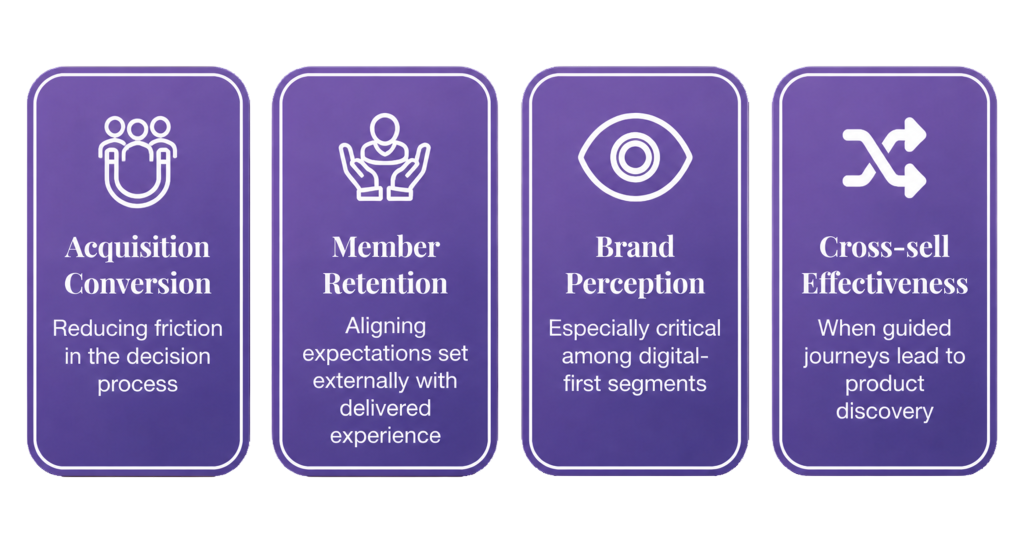
A strategic modernization initiative treats the public website and authenticated banking environment as two phases of a single, continuous relationship. This unified view is not cosmetic. It directly impacts measurable outcomes such as:
- Acquisition conversion – reducing friction in the decision process
- Member retention – aligning expectations set externally with delivered experience
- Brand perception – especially critical among digital-first segments
- Cross-sell effectiveness – when guided journeys lead to product discovery
From Omni-Channel Consistency to Intelligent Continuity
For years, financial institutions have pursued omni-channel consistency, making sure every touchpoint looks aligned. Today, consistency is table stakes. What differentiates leading institutions is intelligent continuity. The ability to deliver relevance, anticipation, and context across every interaction.
This requires bridging multiple data and experience domains:
- Public web journeys and marketing personalization
- CRM and member behavioral data
- Authenticated digital banking flows
- AI-driven insights and advisory hints
- Goal-based guidance embedded in experience
When these domains operate in silos, digital modernization stumbles. When they operate as one ecosystem, the institution becomes something different: a guide rather than a transaction processor.
Predictive Advisory - The Next Frontier
Most digital banking platforms today focus on backward-looking reporting: balance histories, spending categories, and static dashboards. While these tools deliver value, they don’t differentiate. Meanwhile, consumers, especially younger cohorts, are showing growing interest in advice and guidance.
In the U.S., a JD Power Retail Banking Advice Satisfaction study found that financial vulnerability is on the rise, with 43 % of customers considered financially vulnerable (unable to cover six months of expenses), up from 27 % five years ago, and interest in receiving guidance from their financial institution increasing sharply.
This shift reflects a broader change in member expectations: they want a partner in their financial life, not just a place to see numbers. They want anticipation, not just aggregation.
Predictive advisory capabilities, powered by modern data integration and AI, make this possible. Rather than merely reporting historical activity, institutions can:
- Surface patterns in recurring payments and suggest optimization
- Highlight inefficiencies and propose personalized alternatives
- Deliver conversational guidance tied to goals (e.g., saving, budgeting, borrowing)
- Anticipate life events and recommend next steps
This is not theoretical. Institutions that layer predictive insights onto core digital experiences position themselves not just as functional service providers, but as strategic partners in members’ financial journeys.
The Strategic Moment of Platform Migration
Choosing a new digital banking platform is a significant milestone, but it should not be treated as a modernization initiative. Platform transitions to Lumin, G2, VeriPark, eBankIT, Plumery, Backbase, Intellect Design, or Temenos are catalysts, not endpoints.
These transitions create a rare strategic window where:
- Roadmaps are already open for change
- Data architectures are being rationalized
- Executive attention is focused on digital evolution
- Vendors are present in engagement cycles
Smart institutions leverage this window to rethink the broader ecosystem, not just the core or digital banking layer. This means aligning content, data, AI, and experience design strategies in parallel with platform implementation.
Measured wins from this holistic approach can include:
- Higher engagement across digital channels
- Increased member satisfaction scores
- Greater retention and cross-sell lift
- Reduced service costs via guided self-service
Designing for an AI-Native Generation
AI is no longer a futuristic add-on. It is becoming an expectation embedded in everyday digital experiences. The generation entering financial decision-making today (Gen Z and younger Millennials) knows AI as a tool, not a novelty.
They expect:
- Natural language interfaces
- Context-aware recommendations
- Real-time insights
- Intelligent automation
Institutions that make AI visible in member outcomes, not just internal tooling, will differentiate in an increasingly crowded digital finance landscape.
The Real Question
If your credit union is investing in a new digital banking platform, you are already making a meaningful commitment to change. The strategic question is not whether to modernize – it’s how you define modernization.
Is it a technology decision?
Or is it a relationship decision?
Holistic modernization connects acquisition, engagement, intelligence, and advisory into one cohesive member journey. It transforms digital banking from a transaction portal into a guidance platform, and that is how credit unions move from being functional to being indispensable.
Where Do You Begin?
If you are in the middle of a digital banking migration or preparing for one – this is your strategic window.
The platform decision is important.
But the surrounding ecosystem is where differentiation lives.
Before finalizing your roadmap, ask:
- Does our public digital presence align with our advisory ambition?
- Are we integrating marketing, CRM, and digital banking intelligence?
- Are we designing for predictive guidance, not just transaction access?
- Will Gen Z experience coherence across our ecosystem?
- Is AI visible to members, or is it only buried in internal tooling?
Modernization is not about doing more.
It is about connecting what already exists into one intelligent, human-centered system.
If you’re modernizing infrastructure, let’s ensure you’re modernizing the full relationship.
📩 If you’d like to explore what holistic modernization looks like for your credit union, from first click to predictive advisory, let’s connect.
